
Understanding What MCP Gateway Is and How It Works
Use this topic when you want to understand what the MCP Gateway does, why it is needed, and how it fits into your AI security setup before you start configuring it.
Today, AI agents — such as those built on Microsoft Copilot, Salesforce Agentforce, Claude, or custom LangChain agents — connect directly to business applications like Salesforce, Microsoft 365, and Atlassian through MCP servers. These connections happen without any inspection, control, or audit trail. An agent can read or write data freely, and your IT team has no visibility into what is happening.
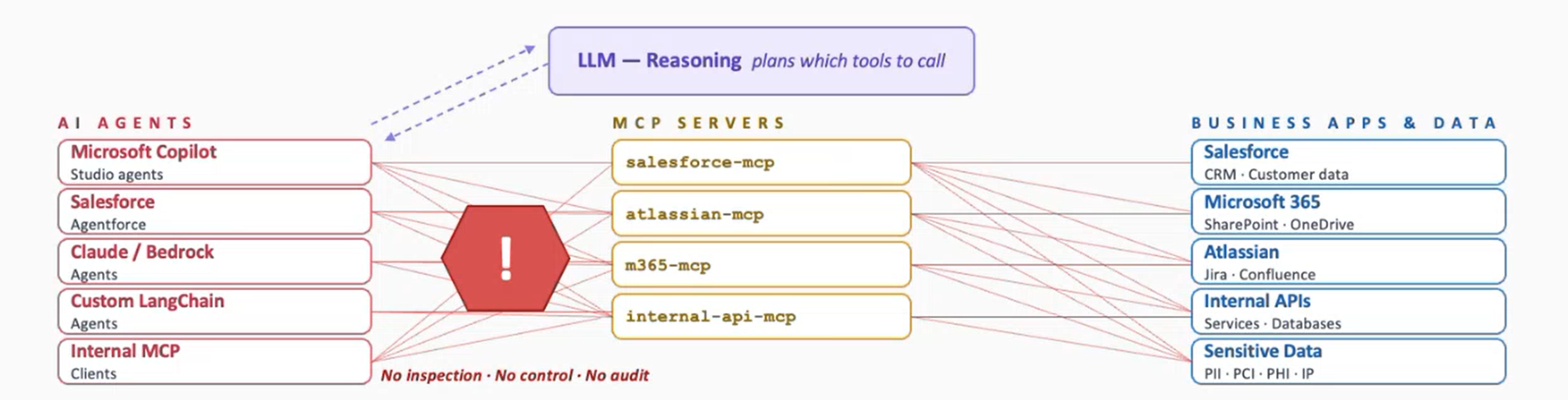
The MCP Gateway sits in between your AI agents and the MCP servers they connect to. Every tool call an agent makes passes through the gateway first. The gateway inspects the request, checks whether it should be allowed based on your policies, and then either permits or blocks it.
For example, if an agent attempts to write customer personal information into Atlassian, the MCP Gateway can send that request to your DLP engine for a verdict. If sensitive data is detected, the gateway blocks the write operation before it reaches Atlassian.
This gives your organisation three things it did not have before:
- Visibility — a full audit trail of every tool call made by every agent.
- Control — granular access control policies that define which agents can access which applications and what operations they can perform.
- Data protection — DLP inspection on both read and write operations to prevent sensitive data from leaking through agent activity.