
About This Guide
This collection guides you through setting up and managing AI Security in the Forcepoint Data Security Cloud Platform. Whether you are connecting your first AI app or governing AI agent traffic across your organization, the topics here walk you through every step in the right order.
What is AI Security?
AI Security is your governance platform for securely adopting cloud AI applications across your enterprise. As your organization embraces AI tools like Claude, ChatGPT, and Microsoft Copilot, you need visibility and control to protect sensitive data while enabling innovation.
The Forcepoint Data Security Cloud Platform's AI Security module gives you centralised governance across all your AI applications — from first connection to ongoing monitoring.
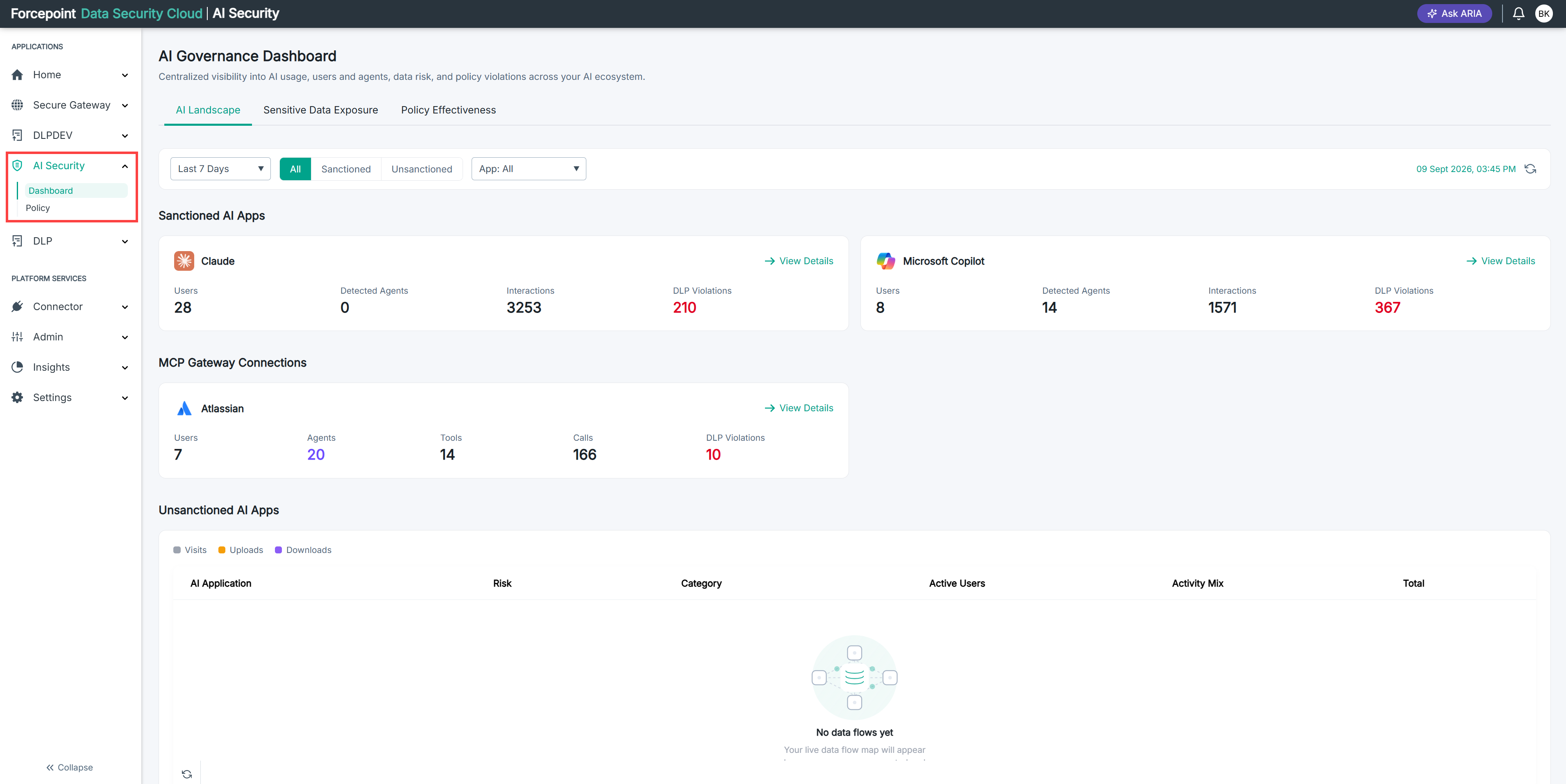
What does this collection cover
The collection is organised into ten chapters. Product Updates comes first and records what has changed. The next six cover things you do: setting AI Security up, connecting it to your applications, and writing the policies that govern them. The last three cover things you read, one for each tab of the AI Governance Dashboard.
| Chapter | What it covers |
|---|---|
| Product Updates | Seeing what has changed in AI Security, and which issues have been resolved or are still open. |
| Getting Started with AI Security | What AI Security does, how it works, what you need before you begin, where to find it in the platform, and how to complete first-time setup, either with the guided setup or by configuring each part yourself. |
| Connect AI Applications | Connecting Claude, ChatGPT, and Microsoft Copilot from the App Connectors page, and managing those connectors once they are set up. |
| Set Up MCP Gateway Connectors | Connecting your business applications to the MCP Gateway so that your AI agents can reach them, reviewing the tools each connector exposes, and controlling how agents authenticate. |
| Register and Manage Agents | Registering the AI agents permitted to use the gateway, issuing and managing their credentials, and grouping them so that a policy can refer to a group rather than to individual agents. |
| Control Access With Access Policies | Creating access policies that control which agents can call which tools, setting them to allow or deny, and ordering them so that the intended policy takes effect. |
| Inspect Content With Data Security Policies | Reviewing the content inspection policies that apply to your AI traffic, seeing what each one detects rule by rule, and creating or changing them in the Data Security portal. |
| Review the AI Landscape | Seeing which AI applications are in use across your organisation, which are approved and which are not, and how your agents are connecting to your business systems. |
| Review Sensitive Data Exposure | Reviewing where sensitive data is being shared with AI applications, which data types are involved, and which individual events need attention. |
| Review Policy Effectiveness | Reviewing how your policies are performing, which ones are matching, and where they may need adjusting. |
| Troubleshoot AI Security | Find out why AI Security is not behaving as you expect, and correct the most common causes, starting with the area of the product where you see the problem. |
Who should use this guide?
This guide is for:
- Enterprise administrators setting up AI Security for the first time.
- Security teams managing ongoing AI governance.
- Compliance officers implementing controls for sensitive data.
Related documentation
AI Security works alongside other products in the Forcepoint Data Security Cloud Platform. You may need one of these guides depending on what you are setting up.
| Guide | When you need it |
|---|---|
| Forcepoint Web Security Cloud | Shadow AI visibility depends on the web proxy. Use this guide to confirm your tenant is set up for it. |
| Forcepoint Data Security (DLP SaaS) | Data protection policies applied to AI interactions are managed in DLP. Use this guide if your DLP is the cloud service. |
| Forcepoint Enterprise DLP (On-Prem) | Use this guide if your DLP is deployed on-premises. AI Security works with both. |
| Forcepoint Data Security Posture Management | Data classification that AI Security uses when evaluating AI interactions. |
| Forcepoint DSE Agent | Endpoint monitoring of AI activity on user devices. |