Elasticsearch Backup
Elasticsearch backup captures all indices and their data, excluding system indices.
Backup Essentials
Purpose: Elasticsearch stores and indexes large volumes of unstructured data for fast search and analytics.
Backup Content: Elasticsearch snapshots of all indices.
Accessing Elasticsearch backup using terminal
Using mc for creating a snapshot
$ kubectl get secrets/gv-es-elastic-user -o go-template='{{.data.elastic | base64decode}}{{"\n"}}'
3jdE4sAs81aL82907fkTtVa7Using terminal to retrieve MinIO credentials
$ kubectl get secret gv-essentials-minio -o go-template='{{.data.rootUser | base64decode}}{{"\n"}}'
NsdlLiCEZBHRLzIb5PdI
$$ kubectl get secret gv-essentials-minio -o go-template='{{.data.rootPassword | base64decode}}{{"\n"}}'
fFeIh8VyxRf45HUIJDgQxn0AcViJV20qa5cRkiP1
$Run snapshot manually
$ kubectl run -it --rm --image=docker.io/getvisibility/backup:0.1.4 debug -- /bin/bash
If you don't see a command prompt, try pressing enter.
root@debug:/# mc alias set myminio http://gv-essentials-minio:9000 NsdlLiCEZBHRLzIb5PdI fFeIh8VyxRf45HUIJDgQxn0AcViJV20qa5cRkiP1
mc: Configuration written to `/root/.mc/config.json`. Please update your access credentials.
mc: Successfully created `/root/.mc/share`.
mc: Initialized share uploads `/root/.mc/share/uploads.json` file.
mc: Initialized share downloads `/root/.mc/share/downloads.json` file.
Added `myminio` successfully.
root@debug:/# curl -X POST -u "elastic:3jdE4sAs81aL82907fkTtVa7" "http://gv-es-http:9200/_slm/policy/gv-essentials-minio/_execute"
{"snapshot_name":"gv-essentials-minio-j6rghefwtuexdlg07uqauq"}
root@debug:/#
Check status of last ran snapshot
$ kubectl run -it --rm --image=docker.io/getvisibility/backup:0.1.4 debug -- /bin/bash
If you don't see a command prompt, try pressing enter.
root@debug:/# mc alias set myminio http://gv-essentials-minio:9000 NsdlLiCEZBHRLzIb5PdI fFeIh8VyxRf45HUIJDgQxn0AcViJV20qa5cRkiP1
mc: Configuration written to `/root/.mc/config.json`. Please update your access credentials.
mc: Successfully created `/root/.mc/share`.
mc: Initialized share uploads `/root/.mc/share/uploads.json` file.
mc: Initialized share downloads `/root/.mc/share/downloads.json` file.
Added `myminio` successfully.
root@debug:/# curl -X POST -u "elastic:FmHaDrJeGkLDfHoSrFeFvJeQrN" "http://gv-es-http:9200/_slm/policy/gv-essentials-minio/_execute?pretty"
{
  "gv-essentials-minio" : {
    "version" : 5,
    "modified_date_millis" : 1729816595792,
    "policy" : {
      "name" : "gv-essentials-minio",
      "schedule" : "0 0 2 * * ?",
      "repository" : "gv-essentials-minio",
      "config" : {
        "indices" : "*",
        "include_global_state" : true
      },
      "retention" : {
        "expire_after" : "30d",
        "min_count" : 5,
        "max_count" : 40
      }
    },
    "last_success" : {
      "snapshot_name" : "gv-essentials-minio-w518btqdsuahriw7pqw9qq",
      "start_time" : 1730132687834,
      "time" : 1730132697502
    },
    "next_execution_millis" : 1730167200000,
    "stats" : {
      "policy" : "gv-essentials-minio",
      "snapshots_taken" : 8,
      "snapshots_failed" : 0,
      "snapshots_deleted" : 0,
      "snapshot_deletion_failures" : 0
    }
  }
}
Backing up elasticsearch-backup bucket
ubuntu@marek-lab:~/gv-backup$ kubectl get secrets/gv-es-elastic-user -o go-template='{{.data.elastic | base64decode}}{{"\n"}}'
73tI55x719TF1T4eb6TLdqeQ
ubuntu@marek-lab:~/gv-backup$ kubectl exec -it minio-backup-pod -- /bin/bash
root@minio-backup-pod:/# mc alias set myminio http://gv-essentials-minio.default.svc.cluster.local:9000 4fBmdCHECPdRU9LsxhcI SiblO9qh3U1abhJAb8UEIEUbl9xRLWf29Drk26xY
Added `myminio` successfully.
root@minio-backup-pod:/# export ES_PASSWORD=73tI55x719TF1T4eb6TLdqeQ
root@minio-backup-pod:/# cat > gv-es-backup.sh << 'EOL'
#!/bin/bash
# Configuration
ES_HOST="http://gv-es-http:9200"
ES_USER="elastic"
BACKUP_DIR="/tmp/es-backup"
REPO_NAME="gv-essentials-minio"
MINIO_BUCKET="elasticsearch-backup"
MAX_WAIT_SECONDS=600 # 10 minutes timeout
# Function to check MinIO connectivity
check_minio_connection() {
echo "Testing MinIO connection..."
MINIO_OUTPUT=$(mc ls myminio 2>&1)
if [ -z "$MINIO_OUTPUT" ]; then
printf "\n\n\n\n\n\n\nError:\n\n MinIO is not configured or not accessible.\n Please ensure:\n 1. MinIO client (mc) is installed\n 2. 'myminio' alias is configured\n 3. MinIO server is running\n\nTo configure MinIO, run:\n mc alias set myminio <MINIO_URL> <ACCESS_KEY> <SECRET_KEY>\n\n"
exit 1
fi
echo "Testing MinIO bucket access..."
BUCKET_OUTPUT=$(mc ls "myminio/${MINIO_BUCKET}" 2>&1)
if [ -z "$BUCKET_OUTPUT" ]; then
printf '\n\n\n\n\n\n\nError:\n\n Cannot access bucket %s.\nPlease ensure:\n 1. Bucket exists\n 2. You have proper permissions\n\n' "$MINIO_BUCKET"
exit 1
fi
echo "MinIO connection successful"
}
check_elasticsearch_connection() {
echo "Testing Elasticsearch connection..."
if ! curl -s -u "${ES_USER}:${ES_PASSWORD}" "${ES_HOST}/_cluster/health" > /dev/null; then
printf "\n\n\n\n\n\n\nError:\n\n Failed to connect to Elasticsearch. Invalid credentials or connection issue.\n\n"
unset ES_PASSWORD
exit 1
fi
}
# Password handling
check_password() {
printf "gv-es-backup.sh\n------------------------\n\n"
if [ -z "${ES_PASSWORD}" ]; then
printf '\n\n\n\n\n\n\nError:\n\n ES_PASSWORD environment variable is not set.\n In terminal, run:\n export ES_PASSWORD=<password>\n\n And then run this script again.\n\n'
exit 1
fi
}
# Password handling
check_password() {
printf "gv-es-backup.sh\n------------------------\n\n"
if [ -z "${ES_PASSWORD}" ]; then
printf "\n\n\n\n\n\n\nError:\nES_PASSWORD environment variable is not set.\nIn terminal, run:\n export ES_PASSWORD=<password>\n\nAnd then run this script again.\n\n"
exit 1
fi
}
# Function to find the current index file
find_index_file() {
index=$(mc ls myminio/elasticsearch-backup/ | \
awk '/index-/ {print $6}' | \
sort -V | \
tail -n 1)
echo "Index: [$index]" > index.latest
echo $index
}
# Function to check if snapshot is complete
check_snapshot_status() {
local snapshot_name=$1
local status=$(curl -s -u "${ES_USER}:${ES_PASSWORD}" "${ES_HOST}/_snapshot/${REPO_NAME}/${snapshot_name}/_status" | grep -o '"state":"[^"]*"' | cut -d'"' -f4)
echo $status
}
# Initial checks
check_password
check_minio_connection
check_elasticsearch_connection
echo "Starting backup process..."
# 1. Execute snapshot policy
echo "Triggering snapshot creation..."
SNAPSHOT_RESPONSE=$(curl -s -X POST -u "${ES_USER}:${ES_PASSWORD}" "${ES_HOST}/_slm/policy/${REPO_NAME}/_execute?pretty")
SNAPSHOT_NAME=$(echo "$SNAPSHOT_RESPONSE" | grep '"snapshot_name"' | sed -E 's/.*"snapshot_name"\s*:\s*"([^"]+)".*/\1/')
if [ -z "$SNAPSHOT_NAME" ]; then
echo " Failed to get snapshot name. Exiting."
exit 1
fi
echo "Initiated snapshot: ${SNAPSHOT_NAME}"
# 2. Wait for snapshot completion
echo " Waiting for snapshot to complete..."
SECONDS_WAITED=0
while [ $SECONDS_WAITED -lt $MAX_WAIT_SECONDS ]; do
STATUS=$(check_snapshot_status "$SNAPSHOT_NAME")
if [ "$STATUS" = "SUCCESS" ]; then
echo " Snapshot completed successfully"
break
elif [ "$STATUS" = "FAILED" ]; then
echo " Snapshot failed"
exit 1
fi
sleep 10
SECONDS_WAITED=$((SECONDS_WAITED + 10))
echo " Still waiting... ($SECONDS_WAITED seconds)"
done
# Find current index file
CURRENT_INDEX=$(find_index_file)
if [ -z "${CURRENT_INDEX}" ]; then
echo " Failed to find current index file. Exiting."
exit 1
fi
echo "Current index file: ${CURRENT_INDEX}"
if [ $SECONDS_WAITED -ge $MAX_WAIT_SECONDS ]; then
echo "Timeout waiting for snapshot completion"
exit 1
fi
# 3. Get UUID for the snapshot
echo "Retrieving snapshot UUID..."
UUID=$(curl -s -u "${ES_USER}:${ES_PASSWORD}" "${ES_HOST}/_snapshot/${REPO_NAME}/${SNAPSHOT_NAME}?pretty" | grep "uuid" | awk -F'"' '{print $4}')
if [ -z "$UUID" ]; then
echo " Failed to get UUID. Exiting."
exit 1
fi
echo " Found UUID: ${UUID}"
# 4. Create backup directory and copy files
rm -rf "${BACKUP_DIR}"
mkdir -p "${BACKUP_DIR}"
echo "Copying snapshot files..."
echo "Required files:"
echo "- meta-${UUID}.dat"
echo "- snap-${UUID}.dat"
echo "- index.latest"
echo "- ${CURRENT_INDEX}"
# Copy files with verification
for file in "meta-${UUID}.dat" "snap-${UUID}.dat" "index.latest" "${CURRENT_INDEX}"; do
echo "Copying $file..."
if ! mc ls "myminio/${MINIO_BUCKET}/${file}" >/dev/null 2>&1; then
echo "Warning: File $file not found in MinIO"
continue
fi
mc cp "myminio/${MINIO_BUCKET}/${file}" "${BACKUP_DIR}/" || { echo "Failed to copy $file"; exit 1; }
done
cd /tmp/es-backup
printf "\n\nList of backed up Elasticsearch content:\n"
find . -type f -exec du -k {} \; | awk '{printf "%d KB\t%s\n", $1, $2}' | sort -n
printf "\n"
cd /
# 5. Create archive
ARCHIVE_NAME="es-snapshot.tar.gz"
echo "Creating archive ${ARCHIVE_NAME}..."
tar -czf "${ARCHIVE_NAME}" -C "${BACKUP_DIR}" .
# Cleanup
# rm -rf "${BACKUP_DIR}"
echo "Backup process completed successfully"
echo "Archive created: ${ARCHIVE_NAME}"
ls -lh "${ARCHIVE_NAME}"
echo "----------------------------------------"
echo "Done."
EOL
chmod +x gv-es-backup.sh && clear && ./gv-es-backup.shTesting Elasticsearch connection...
Starting backup process...
Triggering snapshot creation...
Initiated snapshot: gv-essentials-minio-qc36iwyfrckx9k2tupukiw
Waiting for snapshot to complete...
Still waiting... (10 seconds)
Snapshot completed successfully
Current index file: index-35
Retrieving snapshot UUID...
Found UUID: xqY3LPdNRr-vubBCUaZGAA
Copying snapshot files...
Required files:
- meta-xqY3LPdNRr-vubBCUaZGAA.dat
- snap-xqY3LPdNRr-vubBCUaZGAA.dat
- index.latest
- index-35
Copying meta-xqY3LPdNRr-vubBCUaZGAA.dat...
...vubBCUaZGAA.dat: 28.57 KiB / 28.57 KiB ┃▓▓▓▓▓▓▓▓▓▓▓▓▓▓▓▓▓▓▓▓▓▓▓▓▓▓▓┃ 2.94 MiB/s 0s
Copying snap-xqY3LPdNRr-vubBCUaZGAA.dat...
...vubBCUaZGAA.dat: 1.86 KiB / 1.86 KiB ┃▓▓▓▓▓▓▓▓▓▓▓▓▓▓▓▓▓▓▓▓▓▓▓▓▓▓▓┃ 209.10 KiB/s 0s
Copying index.latest...
...up/index.latest: 8 B / 8 B ┃▓▓▓▓▓▓▓▓▓▓▓▓▓▓▓▓▓▓▓▓▓▓▓▓▓▓▓▓▓▓▓▓▓▓▓▓▓▓▓▓▓▓┃ 868 B/s 0s
Copying index-35...
...backup/index-35: 230.52 KiB / 230.52 KiB ┃▓▓▓▓▓▓▓▓▓▓▓▓▓▓▓▓▓▓▓▓▓▓▓▓┃ 22.74 MiB/s 0s
Creating archive es-snapshot.tar.gz...
Backup process completed successfully
Archive created: es-snapshot.tar.gz
-rw-r--r-- 1 root root 45K Nov 10 03:35 es-snapshot.tar.gz
root@minio-backup-pod:/# root@minio-backup-pod:/# exit
ubuntu@marek-lab:~/gv-backup$ kubectl cp minio-backup-pod:es-snapshot.tar.gz full-backup/es-snapshot.tar.gz
ubuntu@marek-lab:~/gv-backup$ ls -lh full-backup/
total 164K
-rw-rw-r-- 1 ubuntu ubuntu 3.8K Nov 10 00:35 consul-snapshot.snap
-rw-rw-r-- 1 ubuntu ubuntu 47K Nov 10 05:19 es-snapshot.tar.gz
-rw-rw-r-- 1 ubuntu ubuntu 109K Nov 9 21:54 postgres-backup.sql.gz
ubuntu@marek-lab:~/gv-backup$ Result: es-snapshot.tar.gz file containing all ElasticSearch related data inside full-backup folder.
Accessing your Elasticsearch backup using MinIO console
- Navigate to https://10.20.30.40/gv-essentials-minio/ and enter
username/password.
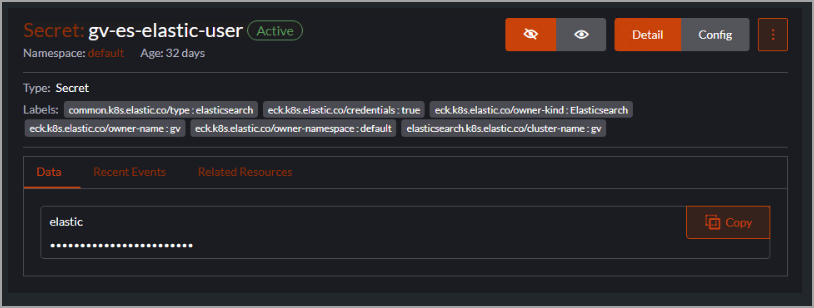
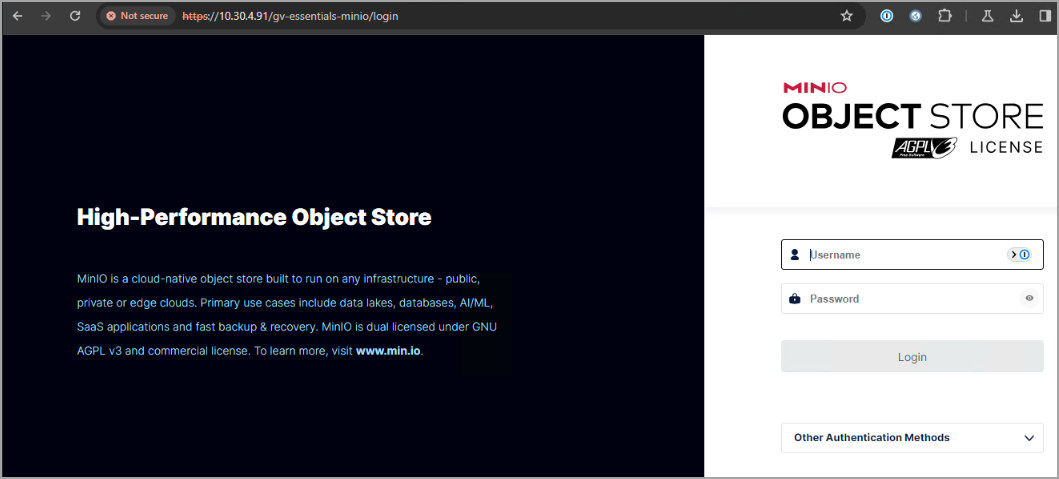 Important:First we need to retrieve Elasticsearch password. You can retrieve Elasticsearch password from either Rancher or using the terminal. In Rancher, find your cluster and navigate to .Note: Username is gv.In terminal, use:
$ kubectl get secrets/gv-es-elastic-user -o go-template='{{.data.elastic | base64decode}}{{"\n"}}' 3jdE4sAs81aL82907fkTtVa7After logging in, you will see the main screen of the MinIO Console.
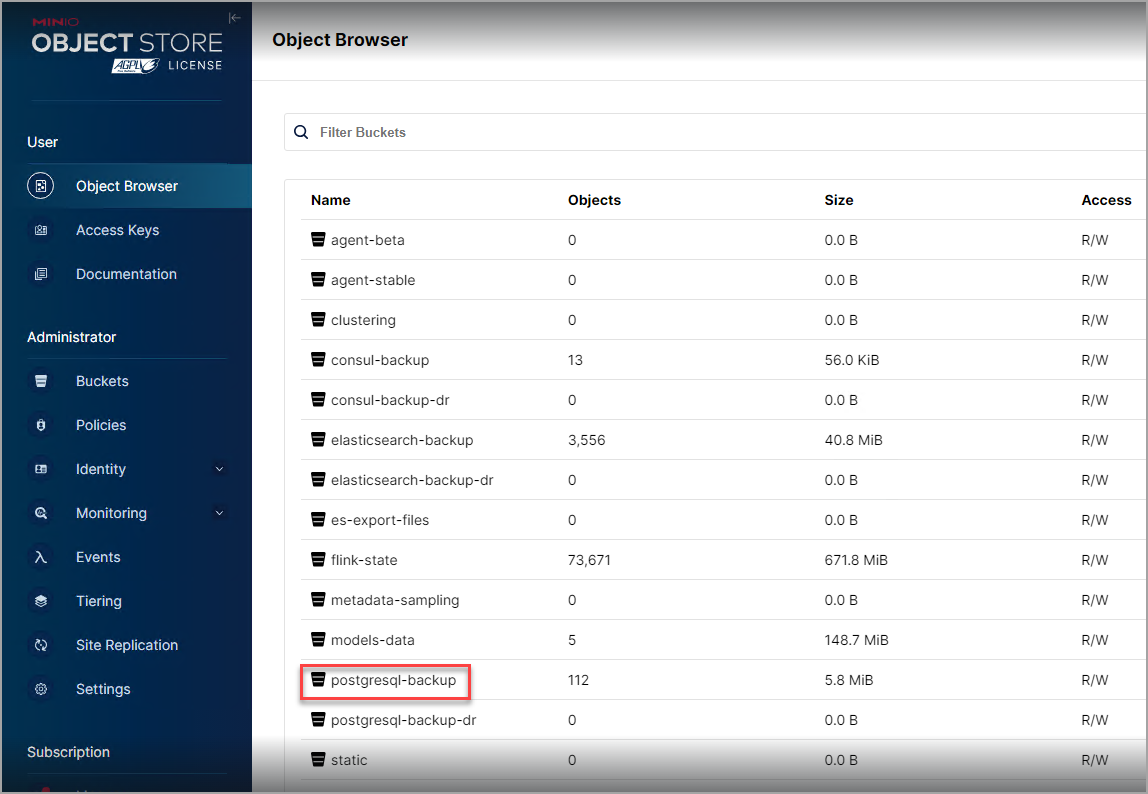
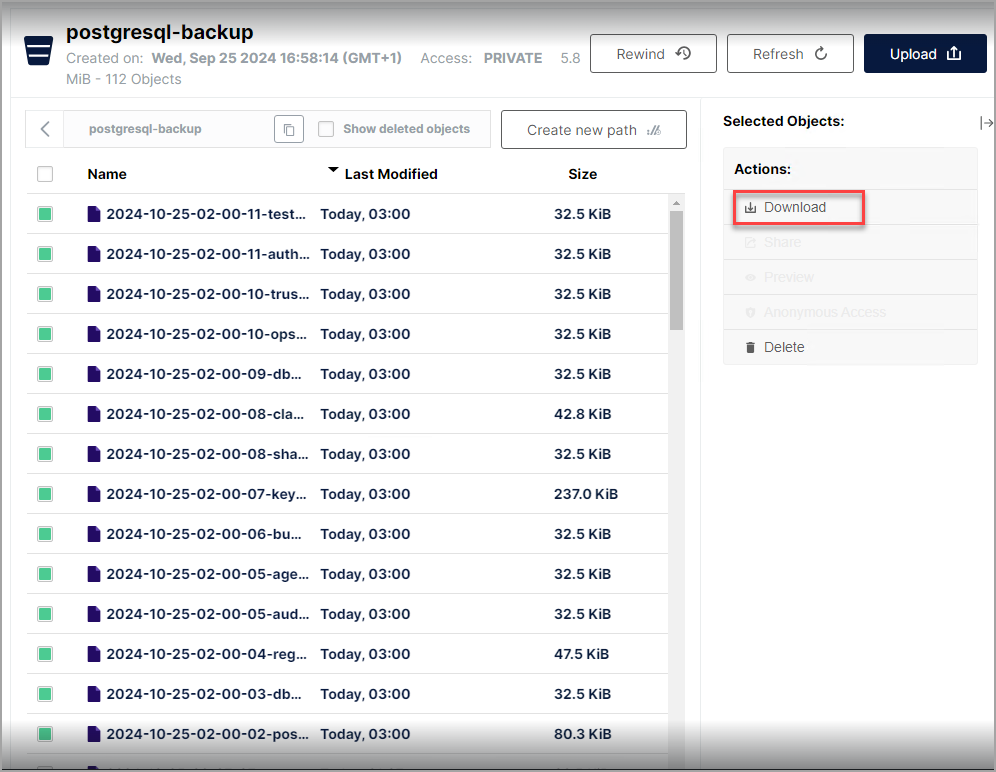
PostgreSQL stores multiple databases, each backed up individually, and a complete backup requires including all of them.
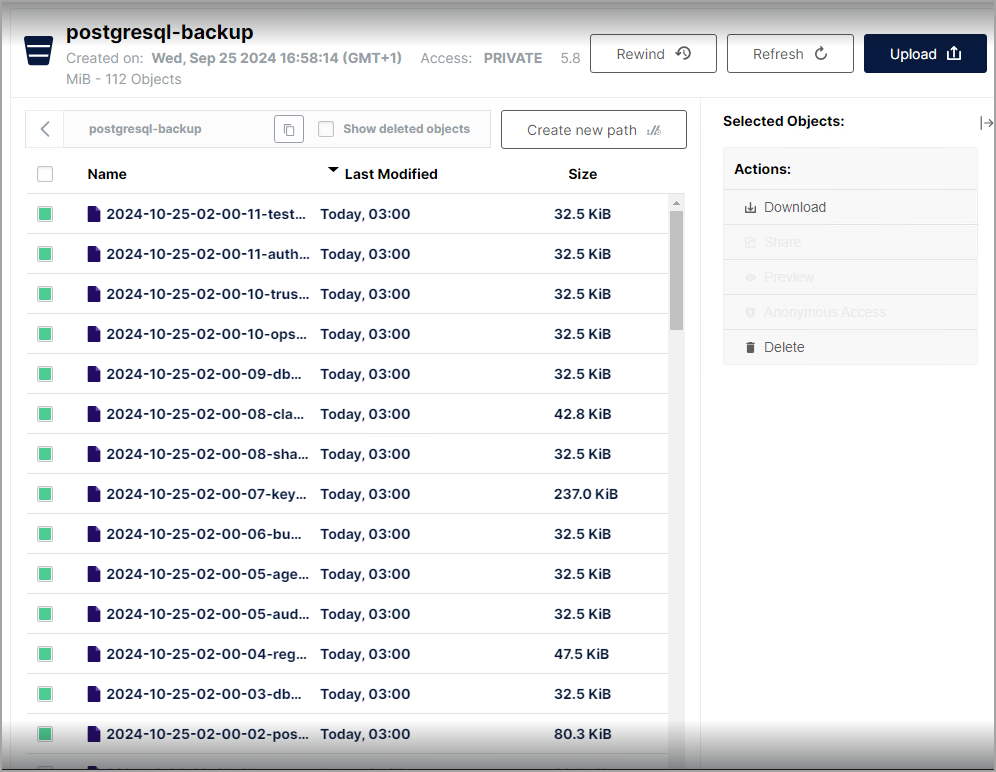
- Click Download to download the backups directly from the browser using the MinIO console.
Additional information about PostgreSQL backups
If you are looking for additional information about PostgreSQL backups, refer to this chapter.
Backup Process:
The es-backup.sh script performs the
following operations:
(Click the file name above to download the script.)
- Retrieves Elasticsearch credentials from Kubernetes secrets
- Establishes port-forward to Elasticsearch service (automatic)
- Tests connectivity to the Elasticsearch cluster
- Uses
multielasticdumpto export all non-system indices - Saves index data to a temporary directory
- Creates a compressed tar.gz archive
- Cleans up temporary files
Running the Backup:
./es-backup.shExpected Output:
========================================
Elasticsearch Backup - Elasticdump
========================================
Archive: ./elasticsearch-backup-20251103-122933.tar.gz
Checking connection... OK

✓ Connected to Elasticsearch
Starting backup...

✓ Backup completed
  Size: 40K
  Indices: 83
  Location: ./elasticsearch-backup-20251103-122933.tar.gz
  Log: ./elasticsearch-backup-20251103-122933.log
What Gets Backed Up:
-
All user-created indices (excluding system indices starting with
.) -
Index mappings and settings
-
All documents within each index
-
Index aliases and templates
Port Forwarding: The script automatically manages port-forwarding to the Elasticsearch service. No manual port-forward setup is required.
Backup File Location: Two files are created:
-
elasticsearch-backup-<timestamp>.tar.gz: The compressed backup archive -
elasticsearch-backup-<timestamp>.log: Detailed backup log